
JANUS-FACED DATA

Janus, the ancient Roman god of beginnings and transitions, was typically depicted with two faces looking in opposite directions. That facial duplicity has often been used to describe deceitful or double-dealing situations. Does the Legacy Media manipulate the news to push their version of the truth? This essay dissects a not so subtle and deceptive article from the Washington Post. The article was intended to influence the narrative of controlling crime in the District of Columbia. The newspaper published the following headline on August 20th: “We asked 604 D.C. residents about Trump’s takeover. Here’s what they said”, and the following sub-headline read, “Though crime continues to be a concern, most residents strongly oppose Trump’s actions and don’t think they’ll make D.C. safer.” Before I discuss that poll in detail, there is some background information that will help to illuminate the debate.
District of Columbia’s Status.
The Constitution, Article I, Section 8, Clause 17, gives Congress “exclusive Legislation in all Cases whatsoever” over the District of Columbia (D.C.), which means Congress is the ultimate authority for policing and governance in the District. In 1973, Congress passed the Home Rule Act which delegated local governance to the D.C. Mayor and Council. This included control of the Metropolitan Police Department (MPD), but Congress retained plenary authority, meaning they have the complete and unrestricted power to make decisions and take actions without limitations. Think of the Home Rule Act as an agreement to keep hands off, unless circumstances warrant otherwise.
President Trump’s Actions.
At an 11 August press conference, President Trump expressed concern for the District of Columbia’s high crime rate, specifically a homicide rate of 27.4 per 100k. He announced a federal takeover of the District’s MPD, the deployment of the National Guard, and the appointment of DEA Administrator Terry Cole as the emergency police commissioner. This effectively placed the MPD under federal control.
Brian Schwalb, the Attorney General of D.C., filed a lawsuit alleging that a hostile takeover of the MPD violated the Home Rule Act which gives the city control of the police. On August 15th, U.S. District Judge Ana Reyes, in an emergency court hearing, brokered a compromise where Pamela Smith retained her position as the D.C. Police Chief and Terry Cole instead became the Department of Justice designee responsible for requesting specific police services. The MPD was required to cooperate with federal immigration efforts, and DC’s sanctuary city status was over-ridden.
Even before the court hearing, President Trump had a patchwork of federal forces over which he had legal control, and who were deployable to D.C. if so desired. A partial list includes: the Park Police, Secret Service Uniformed Division, Capitol Police, FBI, DEA, ATF, U.S. Marshalls, the Federal Protection Service, and Immigration and Customs Enforcement (ICE). He can also legally federalize the D.C. National Guard, which he did. So the bottom line, when the dust settled on August 15th, was that President Trump DID NOT TAKE OVER THE DISTRICT’S MPD, but had a court order requiring the MPD to cooperate with the federal forces he did control.
The Washington Post Narrative.
“Washington, D.C., residents overwhelmingly oppose President Donald Trump’s decision last week to take over the D.C. police and order federal law enforcement and the National Guard onto District streets, and 65 percent don’t think his actions will make the city safer from violent crime, according to a Washington Post-Schar School Poll.”
Although published 5 days after the compromised reached in Judge Reyes court, nowhere in the article does the Washington Post mention the fact that Trump did not actually take over the District MPD. In fact, their whole narrative of outraged citizenry is based on Trump taking control and any poorly informed reader of the Post might still believe that to be the case.
The more pertinent question concerns the makeup of those residents, who in answering question #18, opposed “Trump ordering the federal government to take control of Washington, D.C.’s police department and ordering the National Guard and FBI to patrol D.C.” All well conducted polls publish a methodology which breaks down their sampling into demographics, and then those numbers are adjusted using statistical weighting procedures to account for deviations in the survey sample from known population characteristics. This is a normal process in Polls.
Sampling Demographics.
The following chart depicts the weighted corrections for the Washington Post - Schar School poll.
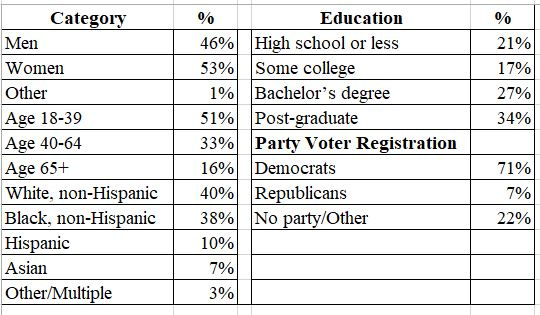
Referring to those poll demographics, what can we surmise about the characteristics of the people who opposed the president on this issue? One could extrapolate that a significant number were Democrats, formally educated with 61% of respondents having degrees, and over half of which were under 40. Pretty much the cohort that matches the deep state denizens who got axed by the Department of Government Efficiency, or whose jobs are threatened by the other ongoing reduction in force endeavors attempting to reign in the bloat of the federal government. The 84% disapproval response to question #4, “Do you approve or disapprove of the way Donald Trump is handling his job as president” pretty much nails the poll’s respondents as TDS suffering progressives.
Is it significant that many liberal D.C. residents who oppose Trump, also oppose one of his policies? Absolutely not, but lost in the attention grabbing headline, and buried deep in the poll methodology is that the Washington Post is offering personal feelings as justification for opposition rather than actually addressing the core issues of DC’s crime problem. More importantly, the Post intentionally misrepresented those opinions to push their narrative. (The links to both the Schar School poll, and the Washington post Article are contained in the Addendum.) The Post reported that 65% of District residents don’t think that Trump’s actions will make the City safer, and only 31% of Washingtonians believing that crime is an “Extremely or Very Serious” problem which was a decrease from a 2024 poll. However, if you add the respondents who believe crime to be “Extremely Serious, Very Serious, or Moderately Serious”, the cumulative poll number is actually 72%. That higher number paints a very different reality than the narrative the Post is trying to push, which is not an unexpected duplicity from a progressive newspaper.
Slightly over half (54%) think the situation is getting better, but is it? The D.C. Police Union has characterized the reported percentage drops in crime as “preposterous”. The Union President, Gregg Pemberton, alleges that police leadership has directed officers at crime scenes to misclassify serious violent crimes as less serious offenses which is a blatant manipulation of the data. That fact that Commander Michael Pulliam who oversees the 3rd District, was placed on paid administrative leave in mid-May amid allegations that he manipulated crime data, downgrading violent crimes to lesser offenses in order to distort crime reporting statistics does lends some credence to the Union's allegations.The Department of Justice has launched a criminal investigation to determine whether the MPD has deliberately and systematically altered violent crime statistics to create a false perception of both safety and police efficiency. This statistical sleight of hand is reminiscent of Pandemic behavior when Hospitals classified a person who died in a motorcycle accident, who happened to have Covid-19, as a Covid-19 death.
Nation-wide Violent Crime Statistics.
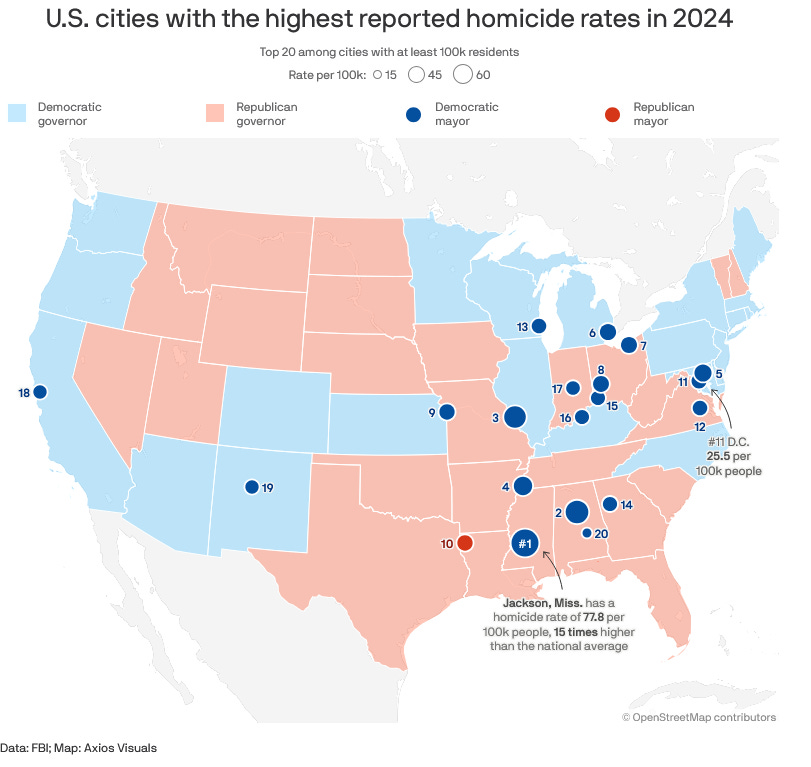
Lost in the media’s kerfuffle over the D.C. violent crime rate is a not unsurprising National trend. Axios News published an article attempting to rebut President Trump’s contention that violent crime is particularly bad in blue run cities in blue run states. Axios documented that 13 of the 20 cities with the highest murder rates were actually in red states. However, they also admitted that in all but one case, Shreveport, LA, those cities were controlled by Democratic Administrations, who were at odds with their state’s Republican Administrations.
The chart depicted below speaks volumes about the void between a conservative and progressive response to violent crime.
Conclusion.
Crime can be a multifaceted topic with data that can be easily tabulated for analysis. Statistics are available on law enforcement policies that illustrate trends, and areas of both success and failure. Unfortunately, that data is also susceptible to manipulation for narrative pushing purposes. Statistics focus on a dispassionate sanitized aspect of crime. The more personal perspective involves acknowledging the damage and emotional toll levied on the victims. The human capitol aspect of crime as it were. It is a combination of the two that will drive the national perception on violent crime and personal safety. This will be a major issue in the mid-term elections. In my opinion, the Trump administration was attempting to address the violent crime problem in the Nation’s Capital. Whether that attempt will be judged as window dressing or successful is yet to be determined. On the other hand, the Washington Post sided with the progressive narrative, and with a deceptively reported opinion poll, deliberately tried to influence the perception that violent crime wasn’t a serious concern.
Addendum.
Link to Schar- School poll: https://www.washingtonpost.com/documents/97620ad1-0767-4609-9edc-c72daaebd9f3.pdf?utm_source=chatgpt.com
Link to Washington post Article: https://www.washingtonpost.com/dc-md-va/2025/08/20/dc-poll-trump-crime-police/
Dick, once again thanks for the continued efforts to provide clarity, reason & proof to offset the MSM gaslighting.
Thanks for taking the time and effort to research and display the naked truth about media duplicity. Excellent.